Why Most Map Rank Tracking Tools Fail the 2-Block Proximity Test
Why Most Map Rank Tracking Tools Fail the 2-Block Proximity Test
Section 1: The Illusion of the “Number 1” Rank
In the world of local search, there is a dangerous lie being sold to business owners and marketing agencies alike. It is the lie of the “Number 1 Rank.” You’ve seen the reports: a clean, professional PDF showing your business sitting at the top of the Google Map Pack for your primary keywords. You celebrate, the agency sends an invoice, and everyone assumes the job is done. But then, you look at your phone. It isn’t ringing. Your lead volume is stagnant. You start to wonder: if I’m number one, where are the customers?
This discrepancy exists because of what I call the “Front Door Bias.” Most traditional rank tracking tools are fundamentally flawed because they check your position from a single, static point – usually your business address or a generic city-center coordinate. This creates a “ghost rank.” You might indeed be rank #1, but only if the person searching is standing literally in your parking lot. This is a vanity metric that ignores the technical reality of google business profile seo.
Google’s local algorithm is built on three immutable pillars: Proximity, Prominence, and Relevance. While many SEOs focus heavily on prominence (reviews and backlinks) and relevance (keywords and categories), they often overlook the sheer power of proximity. In 2026, proximity is more than just a distance measurement; it is a hyper-sensitive filter that can drop your business from the top spot to the second page of results in the time it takes to walk two city blocks. Is your rank tracker telling you the truth about your visibility across the entire city, or is it just telling you what you want to hear to keep the contract alive? If you aren’t testing for proximity variance, you aren’t doing google business profile optimization; you’re just guessing.
Section 2: What is the 2-Block Proximity Test?
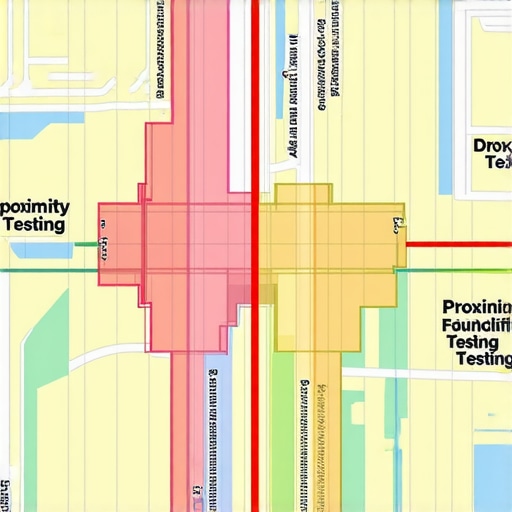
The “2-Block Proximity Test” is a diagnostic framework used to determine the actual reach of a Google Business Profile. It acknowledges a harsh truth: your ranking is not a fixed state; it is a fluid, geographic boundary. If you rank #1 at your office but drop to #10 just two blocks away, you don’t have a ranking – you have a “proximity bubble” that is too small to sustain a business.
In the current local search landscape, Google’s primary goal is to provide the most convenient solution to the user. As mobile device accuracy has improved, Google has tightened the “proximity knot.” In 2026, the algorithm can distinguish between a user searching on one street corner versus another. Traditional trackers fail this test because they rely on “Zip Code” or “City Level” IP spoofing. When a tool tells Google, “Show me results for a user in Beverly Hills 90210,” Google provides a generalized result. But real users aren’t “in a zip code”; they are at a specific latitude and longitude.
When you fail to account for this, you encounter massive data gaps. You might see a green “1” on your dashboard, but a potential client three minutes away sees your competitor. This is why it is vital to understand why your map ranks shift every two blocks and how to verify the data. Without coordinate-level tracking, you are blind to the “rank decay” that happens as a user moves away from your physical location. The 2-block test forces you to look at the “geo-relevance” of your profile. If your authority doesn’t carry past your immediate neighborhood, your google business profile seo strategy is failing to capture the wider market.
To pass this test, a business must demonstrate enough prominence and relevance to “overpower” the proximity of a closer competitor. This is the holy grail of local SEO. If you can rank #2 or #3 while being further away than the #1 result, you have achieved true local authority. Most tools simply aren’t sophisticated enough to measure this battle of inches.
Section 3: Why Traditional SEO Tools Fail the Test
The industry is flooded with legacy software. Over 15,000 marketers rely on “list-based” tracking tools like BrightLocal or Whitespark. While these tools have their place for citation building, they are often disastrous for map tracking. Why? Because they rely on “Average Position” metrics. An average position is a mathematical fantasy that hides the “Red Grid” reality. If you rank #1 in your office but #20 everywhere else in the city, your “average” might look acceptable, but your actual lead generation will be zero.
Traditional tools fail because they don’t visualize the data. They provide a list of keywords and a number next to them. But Google Maps is a spatial interface. To understand how to rank higher on google maps, you need to see the data overlaid on a map. You need to see exactly where your “green zone” ends and the “red zone” begins. This is the difference between list-based tracking and grid-based tracking.
Furthermore, many local seo tools use outdated methods of data scraping that Google easily identifies and serves “cached” or generalized results to. To get the truth, you need a google maps rank tracker that utilizes precise GPS coordinates for every check point. In 2026, “Location still outranks popularity” for the vast majority of “near me” or service-based queries. If your tool isn’t pinging Google from a specific coordinate every 500 meters, it is giving you a low-resolution map of a high-resolution problem.
We see this constantly in local map pack seo: a business owner is frustrated because they have 500 five-star reviews, yet a competitor with 10 reviews is outranking them three blocks away. Traditional tools can’t explain this. A grid-based google business profile audit tool can. It shows that while you have prominence, your competitor has the proximity advantage in that specific micro-neighborhood, and your current optimization hasn’t done enough to bridge that gap.
Section 4: The “Ghost Rank” Phenomenon
The “Ghost Rank” is the silent killer of marketing ROI. It occurs when your SEO dashboard shows success, but your bank account shows stagnation. This phenomenon is almost always a result of a hyper-localized ranking that doesn’t scale. If your map grid is “Green” (Rank 1-3) only in a tiny circle around your office, you aren’t actually visible to the city. You are visible to your neighbors and your employees. This is why you must stop reporting average positions when the map grid is red.
When the phone stays silent despite “good” rankings, it’s usually because of “geo-fencing” issues within the algorithm. Google has effectively put a digital fence around your business because it doesn’t believe you are relevant to users outside of a 1-mile radius. This often happens to businesses that have focused too much on generic keywords and not enough on “location signals.”
To diagnose a Ghost Rank, you need to look at your “Lead to Rank” ratio. If you are supposedly in the Top 3 for a keyword with 1,000 monthly searches, but you only received 5 calls, your rank is a ghost. It exists in the tool’s database, but not in the real world where customers are searching. This is often caused by the tool using a “clean” search environment that doesn’t replicate the messy, location-aware reality of a mobile user. You need to know how to tell if a Google Business Profile expert actually knows the local algorithm, because an amateur will point to the ghost rank as proof of success, while an expert will see the red grid and start working on expanding your proximity radius.
Fixing a Ghost Rank requires a shift from “ranking for keywords” to “ranking for areas.” It involves auditing your profile for geo-relevance gaps. Are your photos tagged with coordinates from the neighborhoods you want to reach? Do your reviews mention specific landmarks or surrounding suburbs? If not, Google will keep your profile locked in its small proximity bubble, and your “Number 1” rank will remain a useless vanity metric.
Section 5: Strategies to Expand Your Proximity Radius in 2026
Expanding your proximity radius is the most challenging and rewarding part of google business profile seo. It is the process of convincing Google that your business is so relevant and prominent that it should be shown to a user even if there is a closer competitor. This is how you dominate a city rather than just a street corner.
Here are the core tactics for 2026:
- Hyper-Local Content: Stop writing generic blog posts. Write about specific neighborhoods, local events, and community projects. Mentioning specific intersections and landmarks near your target areas helps Google associate your business with those coordinates.
- Geo-Tagged Media: Every image you upload to your Google Business Profile should contain EXIF data that places the photo in different parts of your service area – not just at your office. This provides “visual proof” to the algorithm of your local activity.
- Local Citations and Backlinks: Secure links from hyper-local sources like neighborhood blogs, local sports teams, or city-specific directories. A link from a local Chamber of Commerce is worth ten generic SEO guest posts.
- Grid-Based Analysis: Use a google maps rank tracker to identify exactly where your rankings drop off. If you see a “wall” of red at a certain boulevard, that is where you need to focus your next local ad campaign or community outreach.
As I often tell my clients, “The goal isn’t to be #1; the goal is to be #1 everywhere.” Marco Herrera, a leading local seo tools specialist, emphasizes that “fixing the gap between map data and real customer views is the only way to ensure google maps lead generation actually happens. If you aren’t looking at the grid, you aren’t looking at the business.”
By utilizing a google business profile optimization strategy that targets these “weak spots” in the grid, you can slowly push your green circles outward. This is a game of local seo ranking factors that requires patience and precise data. You can’t fix what you can’t see, which is why why map grid data lies to your clients and how to verify it is such a critical concept to master. Once you have accurate data, you can apply these tactics with surgical precision.
Section 6: Conclusion & Call to Action
In the high-stakes world of local search, ignorance is expensive. If you continue to rely on single-point rank tracking, you are flying blind. You are making strategic decisions based on “ghost ranks” that don’t translate into real-world phone calls or revenue. The 2-Block Proximity Test is the only way to truly understand your visibility.
Stop trusting the simplified reports of the past. If you aren’t tracking your performance in a comprehensive grid, you are missing the bigger picture. It is time to perform a real “Grid Audit” and see where your business actually stands in the eyes of your customers. Visit SEO Viper Tools today to access the most accurate google business profile ranking data available. Don’t settle for a “Number 1” rank that only exists at your front door – dominate your entire market and ensure your google business profile seo is actually working for you.