Why Plumbers Lose Map Rankings Even With Hundreds of Reviews
Why Plumbers Lose Map Rankings Even With Hundreds of Reviews: Google Business Profile SEO
It is the ultimate frustration for any service-based business owner: the “Review Paradox.” You have spent years building a stellar reputation, amassing over 500 five-star reviews from satisfied customers. Yet, when you search for a “plumber near me,” your business is buried at position #7 or #12, while a competitor with a meager 40 reviews and a mediocre 4.2-star rating sits comfortably in the top spot of the Map Pack. This discrepancy exists because many believe reviews are the primary driver of visibility, when in reality, google business profile seo is a multi-dimensional puzzle where reviews are merely a “threshold factor” rather than the ultimate ranking signal. In today’s hyper-competitive landscape, Google’s top three organic search results capture the vast majority of local leads, leaving those outside the Map Pack to fight for scraps.
The Proximity Trap: Why Your Office Location Matters More Than Your Reputation
The first and most rigid pillar of the local algorithm is proximity. No matter how many glowing testimonials you have, Google’s primary goal is to provide the most relevant, closest solution to the user. This is what we call the “Proximity Trap.” If your plumbing office is located in a warehouse district on the edge of town, you will naturally struggle to rank in the affluent residential neighborhoods ten miles away, regardless of your review count.
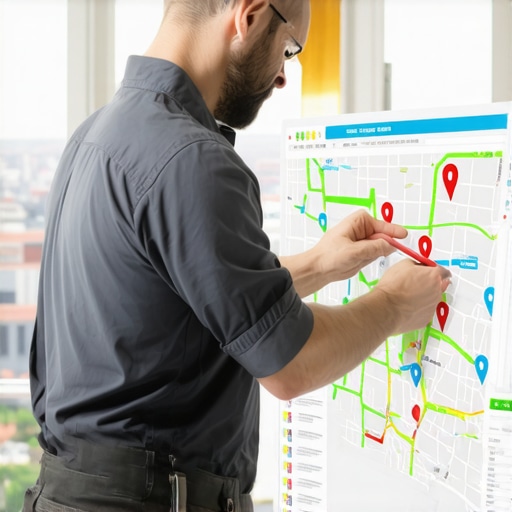
To understand this, you must perform the “2-block proximity test.” Local rankings are not static across a city; they are hyper-local. Your ranking can “drift” or drop off significantly every few blocks. A plumber might be #1 when searched from the parking lot of their office, but drop to #8 just two blocks away. This is Why Most Map Rank Tracking Tools Fail the 2-Block Proximity Test, as they often pull data from a single static point rather than a comprehensive grid. To truly see where you stand, you need a high-frequency google maps rank tracker that visualizes your “reach” across the entire service area.
For plumbers operating as Service Area Businesses (SABs), the proximity trap is even more dangerous. Many contractors attempt to hide their home address while trying to rank in distant cities. This often results in “ranking dead zones.” If you find your visibility is high near your home but non-existent where the high-ticket jobs are, you may need to learn How to Fix Service Area Pages That Attract Traffic But Zero Real Leads. Without a physical, verified presence or high “local intent” signals in those specific neighborhoods, your 500 reviews are essentially shouting into a vacuum.
The Prominence Gap: Beyond the Star Rating
If proximity is the “where,” prominence is the “who.” Google defines prominence as how well-known a business is in the offline world. This is where many plumbers fail. They focus entirely on their Google Business Profile (GBP) and ignore their broader digital footprint. Google’s algorithm crawls the entire web to determine if you are a “Megalodon” in your market or just another local van-and-a-wrench operation. This involves looking at backlinks from local news sites, mentions on industry-specific directories, and the consistency of your brand across the web.
A critical component of prominence is “Review Velocity.” Total review count is a vanity metric; Google cares more about how fast and how recently you are receiving feedback. A competitor getting five reviews a week will often outrank a plumber with 500 total reviews who hasn’t received a new one in a month. This signals to the algorithm that the competitor is more active and relevant to current searchers. This is a core part of google maps ranking service strategies: maintaining a steady heartbeat of activity rather than a one-time surge.
Furthermore, there is often a massive Prominence Gap: Why High-Traffic Competitors Still Dominate Your Local Map Pack. If a large franchise spends thousands on local radio, billboards, and high-authority PR, Google recognizes those brand searches. When people search for that specific company name frequently, Google rewards them with higher general “plumber” rankings because the brand is perceived as an authority. Reviews alone cannot bridge the gap created by a lack of brand authority and external SEO signals.
Technical Sabotage: The “Ghost” Errors Killing Your Visibility
Sometimes, the reason you are losing rank isn’t about what you aren’t doing, but about small, technical errors that act as “sabotage.” The local algorithm is sensitive; even a minor change can trigger a massive ranking drop. One of the most common issues is google business profile seo mismanagement regarding primary categories. If you change your primary category from “Plumber” to “Heating Contractor” because you want more furnace jobs in the winter, you may inadvertently kill your rankings for all plumbing-related terms overnight.
Another silent killer is “Listing Drift.” This happens when a competitor or a malicious actor suggests an “edit” to your location, phone number, or hours, and Google’s automated system accepts it. If your NAP (Name, Address, Phone) data becomes inconsistent across the web – say, your Yelp profile has an old suite number while your GBP has the new one – Google loses “trust” in your data. In the eyes of the algorithm, an untrustworthy listing is a listing that shouldn’t be ranked #1.
To navigate these technical waters, you must know How to Tell if a Google Business Profile Expert Actually Knows the Local Algorithm. Many “experts” focus only on photos and posts, ignoring the technical infrastructure like CID numbers, API-based location synchronization, and the “Megalodon” factor – using advanced tools to monitor for unauthorized edits and category dilution. Without this technical oversight, your reviews are a shiny coat of paint on a crumbling foundation.
2026 Local SEO Trends: AI Overviews and Hyper-Local Grids
As we move toward 2026, the landscape is shifting toward AI-driven local search. Google’s Search Generative Experience (SGE) is changing how plumbers are recommended. Instead of just looking at the average star rating, AI models are now parsing the actual text within your reviews to match specific user intent. If a user searches for “emergency tankless water heater repair,” Google will prioritize the plumber whose reviews specifically mention “tankless repair” and “arrived at 2 AM,” rather than the plumber who just has 500 reviews saying “great job.”
The trend is moving toward hyper-local grids where “relevance” is determined by service-specific entities. Plumbers must encourage customers to mention the specific service provided. A review that says, “John fixed my burst pipe in the kitchen quickly,” is worth ten reviews that say, “Great service!” This is because “burst pipe” and “kitchen” are entities that the AI associates with high-urgency plumbing needs. In 2026, the “Review Paradox” will widen for those who don’t adapt their review acquisition strategy to feed the AI’s hunger for context.
Why Your Map Grid Data Might Be Lying to You
Many plumbing marketing agencies present their clients with “Green” heat maps, showing the business ranking #1 across the city. However, the phone isn’t ringing. This is the phenomenon of “Ghost Ranks.” A map grid can show you are ranking #1, but if that ranking is only visible to the tracking tool’s API and not to actual users due to “personalization” or “search history,” it is a meaningless metric. This is Why Map Grid Data Lies to Your Clients and How to Verify It.
Real-world verification requires looking at store visits, click-to-call data, and “direction requests” rather than just grid positions. Sophisticated local seo tools now integrate with real-time traffic data to show you where your visibility actually results in a lead. If your grid is green but your leads are red, you likely have a “Relevance” problem – you are ranking for terms that don’t convert, or your profile’s “conversion elements” (like your call-to-action or cover photo) are failing to entice the user to click.
Conclusion: How to Reclaim Your #1 Spot
In the world of google business profile seo, reviews are the foundation, but proximity, relevance, and prominence are the walls and the roof of your digital house. Having hundreds of reviews is a fantastic start, but it is not a “set it and forget it” strategy. If you are being outranked by smaller competitors, it is time to look at your review velocity, your technical category health, and your brand’s prominence outside of the Google ecosystem. Stop relying on vanity metrics and start looking at the hyper-local volatility of your market. To truly dominate the map pack and rank google business profile listings effectively, you must audit your profile with the same precision you use to diagnose a complex repiping job. Reclaiming your #1 spot requires a shift from “getting reviews” to “building authority.”